PROJECTS
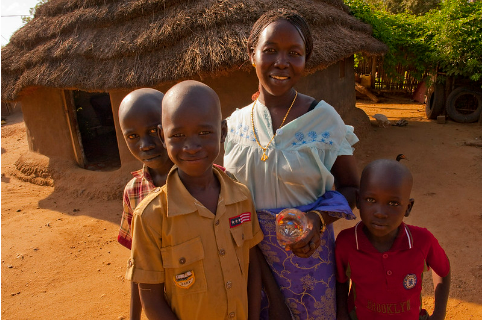
Displaced Livelihoods in South Sudan
A family in South Sudan © Arne Hoel / World Bank
South Sudan hosts one of the world's most acute displacement crises, with millions of Arab refugees settling alongside host communities in areas of scarce resources. Tensions between displaced and host populations are common, fuelled by competition over aid and livelihoods. This study asks whether deliberately structuring livelihood programs to bring these groups together and to collaborate toward shared economic goals can improve both program effectiveness and intergroup relations.
Using a factorial 2×2 randomized design, we assign approximately 800 participants across 400 pairs to conditions that vary group composition (heterogeneous refugee–host pairs v. homogeneous refugee-only or host-only pairs) and task structure (collaborative joint business proposals vs. individual proposals). All participants receive the same entrepreneurial skills and business development training; what varies is who they work with and whether they are asked to develop a proposal together. Pairs submitting the strongest proposals receive seed funding to launch their business, providing real-stakes incentives for engagement. This design allows us to estimate the independent and interactive effects of contact and collaboration on social cohesion, intergroup attitudes, willingness to cooperate, and proposal quality.
The study is implemented in Unity, Northern Bahr El-Ghazal, and Warrap states in partnership with Youth Action Against Poverty (YAAP). It is funded by Innovations for Poverty Action in collaboration with the IKEA Foundation.

Reconciliation, Repatriation, and the Reintegration of Former ISIS Members in MENA
Between 2013 and 2019, over 53,000 individuals from more than 85 countries travelled to join ISIS in Iraq and Syria. Fewer than 6,000 have returned home. Tens of thousands remain detained across the Middle East and North Africa. Governments now face the fundamental question of whether citizens who joined ISIS should be repatriated, prosecuted, or indefinitely confined abroad. But it is unclear under what conditions repatriation and reconciliation can succeed. Long-term viability depends not just on legal frameworks or security assessments, but on public acceptance. Despite years of political and media attention, we lack systematic evidence on how communities most directly affected by ISIS recruitment evaluate former members and draw moral boundaries between forgiveness, punishment, and exclusion.
This project addresses this limitation through a comparative, multi-method study across six countries in the MENA: Morocco, Tunisia, Algeria, Egypt, Saudi Arabia, and Jordan. Using a two-wave panel survey, we deploy two experiments. The first is a forced-choice conjoint that isolates how returnee attributes shape public support for repatriation, reconciliation, and punishment. The second is a perspective-taking intervention that asks respondents to imagine themselves as a former ISIS member seeking to return home, testing whether induced empathy can reduce perceived threat and soften punitive attitudes. Fieldwork in Morocco and Tunisia complements the survey evidence with elite interviews, focus groups, and trauma-informed interviews with former members of ISIS.
Violence of Law: Legal Governance, Anti-Terrorism Laws, and The Escalation of Violence
Over the past two decades, anti-terrorism laws have proliferated around the world, reshaping how states confront armed groups. But their consequences remain poorly understood. This project develops and tests a theory of legal backlash, suggesting that anti-terrorism laws can escalate rather than suppress violence when states lack the legitimacy to enforce law impartially. In weakly institutionalized settings, these laws expand coercive power without resolving underlying grievances, provoking resistance over compliance.
We evaluate this argument using a nested mixed-method design across four studies. Study 1 introduces original data on anti-terrorism legislation across 17 West African and Lake Chad Basin states (2000–2024) and estimates the causal effect of law adoption on violence. Study 2 uses a re-treatment design to assess whether legal amendments trigger further escalation. Study 3 turns to subnational variation in Nigeria, combining local measures of coercive capacity with interviews with security actors, former combatants, and civilians to identify the mechanisms at work. Study 4 fields a survey experiment in Nigeria to test whether legal framing shapes public beliefs about the legitimacy and expected consequences of enforcement.
Across all four studies, we find that anti-terrorism laws systematically generate violent backlash under conditions of weak legitimacy. Laws are not neutral instruments of order but political interventions that can, in fragile settings, generate the very violence they seek to prevent. The findings carry direct implications for counter-terrorism policy, legal reform, and international assistance programs across the Sahel.